Thursday, September 28, 2006

Sighisoara, Vlad's Birthplace; World Heritage site


Sighisoara: Birthplace of Vlad Tepes
The Home is now a Restaurant
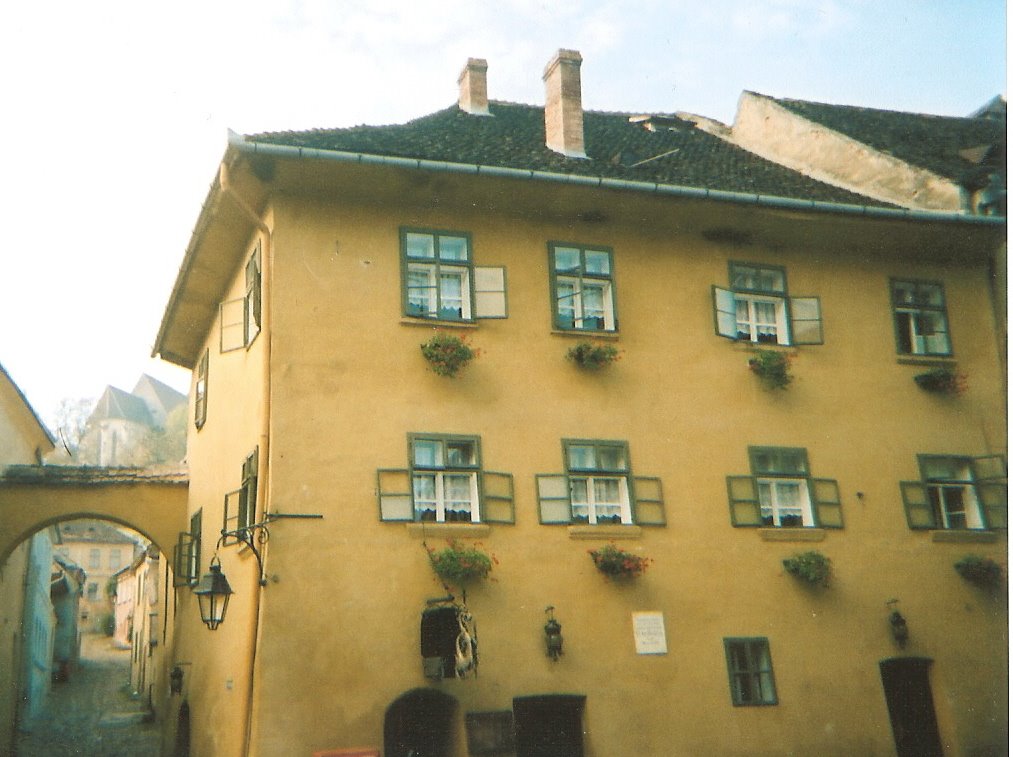
1.  Birthplace: The big yellow house.

The home where Vlad Tepes was born in 1431 is now a restaurant. Expect and get generous portions of good basic food. Sauces and frills are few, so the atmosphere seems authentically Romanian.

The town is in excellent medieval condition, never bombed, or overrun. See the photo gallery at http://www.world66.com/europe/romania/sighisoara/lib/gallery.Although he ruled Wallachia for periods in a brief timespan, 1456-1462, his reputation suggests a far longer domination.

2.  Monuments and The Novel.

There are references to Vlad Dracula in many places, and they often refer to the novel, "Dracula", by Bram Stoker, even though it is far removed from the life.  Reread the Stoker novel at Dracula, http://www.literature.org/authors/stoker-bram/dracula/

As in other Romanian cities with ties to Vlad Tepes, there are excellent descriptive plaques in Sishisoara. They separate out the kitsch, giving historical information particularly where Bram Stoker made other claims. The result is to interest people who want to know what really is known, or reasonably so; as well as those who want to follow in Bram Stoker's characters' steps without critique.

There are entire tours devoted to Vlad. The Romanian Tourist Bureau provides an overview of his life as told in legend. See http://www.draculascastle.com/html/poenari.

3.  World Heritage

Sighisoara is a World Heritage site. See http://www.romanianvoice.com/images/orase/sighisoara.php. The full list of places on the Romanian World Heritage honor roll is at http://www.thesalmons.org/lynn/wh-romania.


Monday, September 25, 2006

Bistrita, Piatra Fontanele and Hotel Castel Dracula: Bram Stoker's Dracula Story

 Bistrita
Bram Stoker's "Dracula"

Bistrita is the town located near the area where the "Dracula" author, Bram Stoker, located his fictitious Dracula's castle.

His character, Jonathan Harker dined at the Golden Crown here.  Bram Stokerwas born in Dublin -  see http://www.online-literature.com/stoker/. This is the Literature Network site.

1.  Weekend slowdown.

On weekends in Bistrita and other towns, things do close down, so don't plan for museums or sites after lunch and especially on Sundays. Find an overview of the town at http://www.museum.ici.ro/transilvania/bistrita-nasaud/english/istoria%20oras.

A walk around was all we wanted.

2. Hotel Castel Dracula

It was time for kitsch, so we stayed here.  The good news is that the kitsch is restrained, and localized. The rest of the accommodation is a fine hotel, although in need of some repair. 

Hotel Castel Dracula, near Bistrita, Romania

Hotel Castel Dracula is to the east, past Bistrita, and supposedly at the place where the fictitious castle in the novel, Dracula, was supposed to be located.


3.  Kitsch

The hotel has a secret passageway and room, that you have to search for yourself and then - gasp - it is there. The Coffin. And cape for dressing up.


Dan Widing locates The Coffin, Hotel Castel Dracula, Romania

Other than that, it is a full-service, comfortable hotel: good food, books for sale in the lobby, much research on the Stoker's Dracula-Vlad comparison.

Wish for a foggy morning so that driving is risky. The horsecarts are a hazard despite reflectors.

Then you will have to stay a few hours longer, and curl up with a good book.

4.  Hiking Center

The hotel has been discovered by serious hikers. It is near a wilderness park, with Big Animals (real wolves and bears), and the trails look great.

5.  Games

There is also a pool table and pub up the tower. For enviro-tourists, despite the touristy name Castel Dracula, stay here as your base for side hikes. Any big facility needs upkeep, and they are working on it.

Other accommodations:

6.  Warmth

We had no difficulty with cold nights.

Usually we stayed at any family pensione, or a "cabana" in outlying areas. A cabana is like a villa, small hotel-hostel-pensiones for travelers, at well-spaced intervals in mountain or recreation areas. All clean, safe, warm, with thin compact mattresses, but plenty of felted blankets in the duvets. The felted blankets, think heavy, tight wool blankets, soaked and dried several times to tighten it up and make the felt, very thick - not like hats. We sometimes put the additional duvet underneath.

Wednesday, August 23, 2006

Resources: Reading list, chronology, reference sites, compare to Bram Stoker "Dracula"

Overview - There is a historical Vlad III Tepes, who may or may not conform to your own acquired understanding of him. Please put him in his own setting, with the dangers he and his countrymen faced, with the practices of others in his time, and look for his other qualities as a ruler - not just his extreme law-enforcement or cruel deterrent practices. For people who like heavy deterrence, and believe in it, this worked for Vlad but only lasted several decades. The Turks (fill the slot with any other invader) were back. Torture is temporary, and has its backlash.
  • For a novel about Vlad, try The Historian, by Elizabeth Kostova, 2005, Little, Brown&Co.
  • Overview and photos, sites and related issues: www.donlinke.com/drakula/vlad/photos., for Vlad Photos, sites.
  • Narrative, chronology, facts and resource list at www.royalty.nu/Europe/Balkan/Dracula. I was interested to see that Vlad was raised by Turks, a hostage as a child, or at least whatever one calls a person who is being kept as a guarantee that the father will conform to what the holder wants. He may have learned much, early.
  • More photos and a journey log: www.dunwich.org/draculea/draculea. Also, photos at www.ciaoromania.com/draculatour.
  • Here is a site showing where many stories originated: www.tabula-rasa.info/DarkAges/VladTheImpaler. This is a horror-site, so if you get to the home page, please do not leave in disgust. Just go fast to the Dark Ages section then in the left menu, to Vlad. The written account there is ok.
  • Here, an overview with list of resources and footnotes. www.eskimo.com/%7Emwirkk/castle/vlad/vladhist.
The sites for Vlad III Tepes, Impaler, are fine to see, but may detract from the rest of Romanian culture and places. So we put the Vlad sites at their own blog.

Because any visitor will be constantly reminded of Vlad, here are some reading materials to help determine what is fact, with reasonable corroboration, and what is legend, and what is sheer fiction - literally, thanks to Bram Stoker, the author and his "Dracula."

Reading materals here, for your next trip to the library or on-line source:

1. Bram Stoker, "Dracula" (the nineteenth century novel)
2. Elizabeth Miller, "A Dracula Handbook," Gerot Publishing House, Bucharest, Romania (English version-973-96601-4-2) (among books recommended by the Transylvanian Society of Dracula)
3. Ioan Praoveanu, "Castle Bran," C2 Design House Publishing, Brasov,Romania, 1999
4. Raymond T. McNally and Radu Florescu, "In Search of Dracula, a True History of dracula and Vampire Legends," New York Graphic Society, Greenwich, Connecticut 1972.


We had these books with us:

1. Lonely Planet's "Romania and Moldova"
2. History of Romania (paperback, in the house here somewhere, well-dog-eared)

The Name - Vlad III Tepes

All the names and what they mean, collected from a collection of sites:

a. Vlad. First name. See members.aol.com/johnfranc/drac05.

b. III. His father was Vlad Dracul, or Vlad II, I understand, so this Vlad is Vlad III.

c. Tepes. Impaler. See www.royalty.nu/Europe/Balkan/Dracula.

d. Dracula. Dragon, as in Order of the Dragon, to which Vlad's father first belonged, then Vlad. See www.rodoslovlje.com/medieval_serbia/eng/history-dragon.

See www.donlinke.com/drakula/vlad. This is a good site for the historical Dracula.

Hunedoara: Johan Hunyadi - Vlad Contemporary, Ruling Transylvania

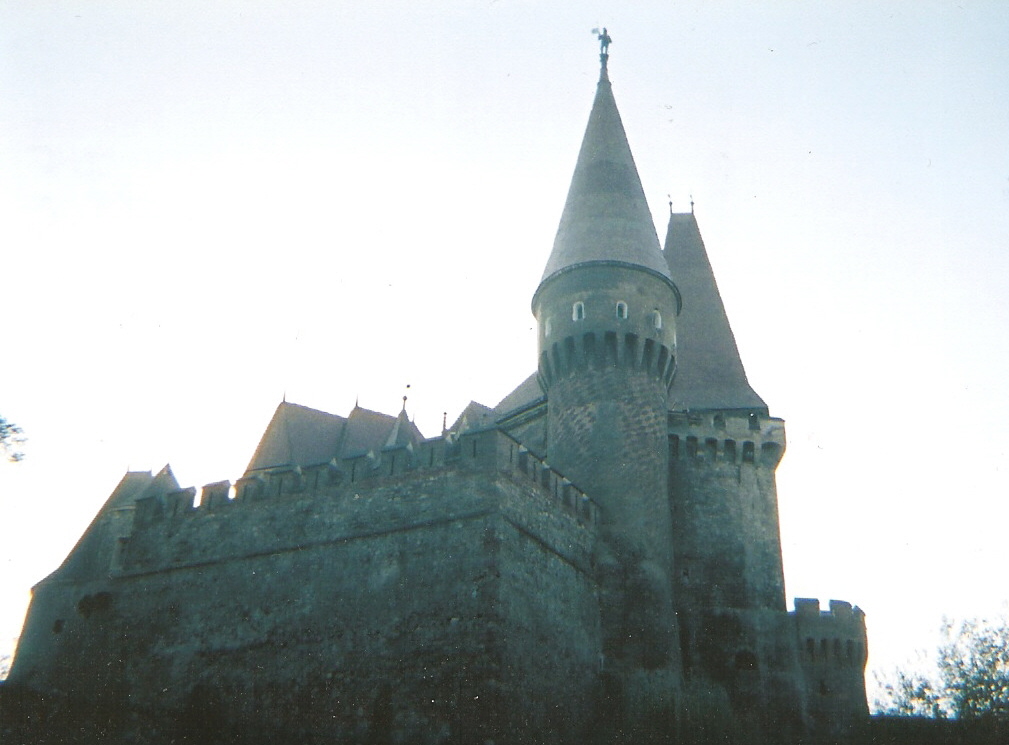
This is fabulous. Maybe the best castle in Europe. Never bombed, in process of a fine reconstruction of the wooden parts and others needing preservation. Location=terrible. Abandoned communist era factories all around. Go anyway.

Corvin Castle in the eastern part of Romania. Castle of Janos Hunyadi, Hungarian - allied with Vlad off an on, both against the Turks. Hunyadi also ordered the assassination of Vlad's father and brother.

Hunyadi ruled the northern Transylvania; Vlad ruled the southern Wallachia. Janos' son ruled after him. See Hunedoara Castle at www.world66.com/europe/romania/hunedoara. Janos Hunyadi - John Hundedoara (see Huneduara in Croatia) - or Johan, was a Hungarian nobleman and general who was appointed as administrator of the area by the Hungarian rulers in the 15th century. He repelled the Ottoman invasion for many years. See www.infoplease.com/ipa/A0107349.

Some sources credit Hunyadi with saving Europe because he halted the Turkish advance into southern Europe. See www.ucalgary.ca/applied_history/tutor/endmiddle/bluedot/hunyadi.

The castle is 14th Century Gothic, never bombed, never cannoned. The restorations are splendid. The surroundings, however, are eastern european socialist looming skeleton factories - no glamor entryway - but the trip is worth it. Watch out for heavy air pollution after Cluj Napoca and Deva. Asthmatics take inhalers, and do not even think about the fallout on crops, and that the animals are eating in the fields. People and vehicles barely visible in the smog. How will the EU help with health?

Best history site, History of Central Europe - Vlad Tepes and Romania

Go to the History of Central Europe at mysite.du.edu/~etuttle/misc/europe.htm#Mong. Scroll down to the Romania section. This is the most concise but clear and complete accounting we have found so far.

Lake Snagov

This is not only the Lake where Vlad's burial (?) island at the monastery, is located, so they say. It is also a vacation spot, where fine estates line parts of the shore. As you are rowed out to the island and the monastery, you will also see Ceaucescu's palace, fishermen, and so quiet.

There are plenty of sites for Vlad - see a good collection at //www.donlinke.com/drakula/vlad/photos.

This one suggests that you get off those usual ones, and spend time with the Lake before it also is built up, the more of us that come there. You can stay at the Complex Astoria, a communist-era resort there. This was taken from a dock.

Many homeless dogs. We were told to keep our hands in our pockets, so we did. They trot along with you, just don't pet. Others not so friendly. Don't experiment. We understand that Ceaucescu would not let people take their pets when they were moved wholesale in Bucharest and elsewhere out of neighborhoods that were then razed for big government buildings and boulevards, into high rises. Puppies, show dogs, all set loose. Thousands.

Targoviste, Court, Vlad's Capital, Vlad as Ruler of Wallachia


Targoviste was the capital for Vlad III Tepes during one of his periods of rule over much of Wallachia. It is not far from Bucharest, and in the direction most tourists do not travel. See photo and comment at www.aboutromania.com/dracula4. There is a tall tower, full of exhibits and information. Wind your way up the large stairs and by the end, looking over the countryside from the top, you feel you perhaps have the beginning of an understanding. He was brutal, but is still revered for other things.

Most tourists head north, to Brasov, and Bran Castle (where Vlad either had been a guest a few times, or imprisoned there for a while, but no other connection we were told).

Targoviste has more than this small website suggests, but start here to get an overview: www.world66.com/europe/romania/targoviste.

The stories of Vlad III Tepes, the Impaler, vary. This one seemed reliable: www.royalty.nu/Europe/Balkan/Dracula. Note that Vlad III Tepes is different from the fictional Dracula in the Bram Stoker novel, "Dracula."

I read that Vlad's brutality could have resulted from his exposure to it as a youngster, inflicted on others where raised for a time among the Turks (no suggestion that he was brutalized), and he just got used to it. Others say that he was no worse than other medieval beings, and our own inquisition and carpet bombings and napalm are no winners, just farther removed from the sounds and visuals of what he was inflicting. This site examines what happened in a broader context: members.aol.com/johnfranc/drac05. Photo included. The address is there if you want to contact the Transylvanian Society of Dracula.

Bucharest, Curtea Veche,The Princely Court - Vlad


An earlier post, about Targoviste, used the term, "Princely Court," for that location.

"Princely Court" is also used here, for Vlad's court location after moving the political center to Bucharest. See www.rotravel.com/romania/sites/tour/old.php.

The area is a combination of ruin and structures, but is in process of reconstruction. Its history is given at library.thinkquest.org/C0125971/media/english/Map/bucu. Excavations are ongoing.

Here are photos and a description - en.wikipedia.org/wiki/Curtea_Veche. Good old Wikipedia.

Sunday, August 20, 2006

Bucharest, Dracula Club, fried rats to eat

The Dracula Club, Bucharest, Romania
 .
The Dracula Club, Bucharest. Excellent for Halloween. Knock, and a little door in the big door opens and a face peers out. This is a reputable fine food supper club-restaurant, not just a come-on.

You will like the clientele.


Dan Widing welcomed at the Dracula Club, Bucharest, Romania (on Halloween)
.
People emerge from the walls. Enjoy the fried rats - looked like chicken breast with dark pumpernickel breadcrumb coating, pimento puree within, and long tails and whiskers of something, perhaps fried angel hair pasta?

Halloween was dress-up night. Watch for the really good actor who suddenly descends, seeking Mina, Mina, Mina; and grabbing bites where he can. See "Dinner At The Count's" at www.travellady.com/Issues/Issue60/dracula.>. There was a group of American tour guides there, not a friendly group at all. One even said aloud, in the face of a lavish and excellent buffet, that she never ate local food, and I hope she chooses another career.